
 Published: 17 Nov 2026



Learning how to play roulette begins with understanding a simple sequence: bets are placed on selected outcomes, the wheel is spun, and the result is determined by the numbered pocket in which the ball lands. Bets covering the winning result receive the applicable payout, while other bets lose.
The fundamentals are straightforward, but understanding the roulette table, the different bets and the mathematics behind them makes the game easier to follow. This guide explains the rules of roulette, how online roulette works and why every spin remains a matter of chance.
How to Play Roulette Step by Step
There are six main stages to a standard roulette round. The process is broadly similar in physical, live dealer and digital versions, although the way the result is produced differs.
Step 1: Understand the Roulette Variants
Roulette is available in several formats. European Roulette uses a wheel with one zero, while American Roulette includes both zero and double zero. French Roulette normally uses a single-zero wheel, sometimes with additional rules for certain bets.
These differences affect the number of possible outcomes and the house edge.
Step 2: Understand the Stake
A stake is the amount placed on a bet. Roulette tables display minimum and maximum betting limits, which can vary between games.
The table's stated limits should be checked before any wager is considered. The full amount staked can be lost.
Step 3: Understand How Bets Are Placed
The betting table contains numbered squares and designated areas for groups of numbers.
A chip placed directly on a number represents a straight-up bet. Placing it on a boundary between two numbers represents a split bet. Other positions cover colours, numerical ranges, dozens or columns.
Each bet has its own coverage and standard payout.
Step 4: The Wheel Is Spun
In a traditional or live dealer game, a croupier spins the wheel and releases a ball around its outer track.
In digital RNG roulette, software generates the result through a Random Number Generator.
Betting closes at a defined point in the round. Once closed, bets cannot normally be changed.
Step 5: The Result Is Determined
On a physical roulette wheel, the ball slows and eventually settles into a numbered pocket.
The winning number and its colour are then displayed. In an RNG game, the system reveals the randomly generated result.
Step 6: Bets Are Settled
Any bet that covers the winning outcome receives its stated payout. Other bets lose.
For example, a £1 bet on red in standard European Roulette pays 1:1 if the result is red. This would produce £1 in net winnings, plus the original £1 stake returned.
If the ball lands on black or zero, the red bet loses.
Mega Casino Tip: The game's information panel should explain the wheel variant, available bets, applicable rules and payouts. These details matter more than patterns shown in previous spins.
Roulette Explained: The Wheel, Ball and Betting Table
Roulette is a casino game in which the result is determined by a numbered pocket on a wheel, or by the equivalent result in an RNG-based version.
The main components are:
- Roulette wheel: The numbered pockets that determine the outcome.
- Ball: The small ball that settles into a pocket on a physical wheel.
- Betting layout: The separate numbered grid and additional betting areas.
- Chips: The markers representing wagers.
- Croupier: The person responsible for operating a traditional or live roulette round.
- Payout: The amount paid for a winning bet under the game's rules.
The objective is to select one or more outcomes before betting closes. There is no requirement to predict the exact number, since many roulette bets cover several possible results.
The number of pockets, the type of bet and the payout determine the mathematical probability of a winning result.
How Many Numbers Are on a Roulette Wheel?
A European roulette wheel has 37 pockets, numbered from 0 to 36. An American roulette wheel has 38 pockets, numbered from 1 to 36, plus 0 and 00.
Both versions contain 18 red numbers and 18 black numbers. The zero pockets are green.
|
Wheel feature |
European Roulette |
American Roulette |
|
Total pockets |
37 |
38 |
|
Numbers 1–36 |
36 |
36 |
|
Red numbers |
18 |
18 |
|
Black numbers |
18 |
18 |
|
Zero pockets |
One: 0 |
Two: 0 and 00 |
|
Standard house edge |
2.70% |
5.26% |
The additional double-zero pocket is the principal mathematical difference between the two versions.
On a European wheel, a straight-up bet has one possible winning outcome among 37 equally likely pockets. On an American wheel, the same type of bet has one possible winning outcome among 38.
Why the Zero Matters
Zero is not included in the standard red, black, odd, even, high or low groups.
In ordinary European Roulette, a bet on red loses if zero appears. The same applies to black, odd, even and the other even-money categories.
The payout for a red or black bet is 1:1, even though the probability of red or black is slightly below 50%.
That difference contributes to the house edge.
Are Roulette Wheel Numbers in Numerical Order?
No. The numbers are arranged around the wheel in a non-sequential order.
The layout on the betting table is different. It presents numbers 1 to 36 in three columns, making it easier to identify combinations and betting positions.
The physical wheel order and betting-grid order serve different purposes. Neither creates a reliable pattern for predicting future results.
Roulette Table Layout Explained
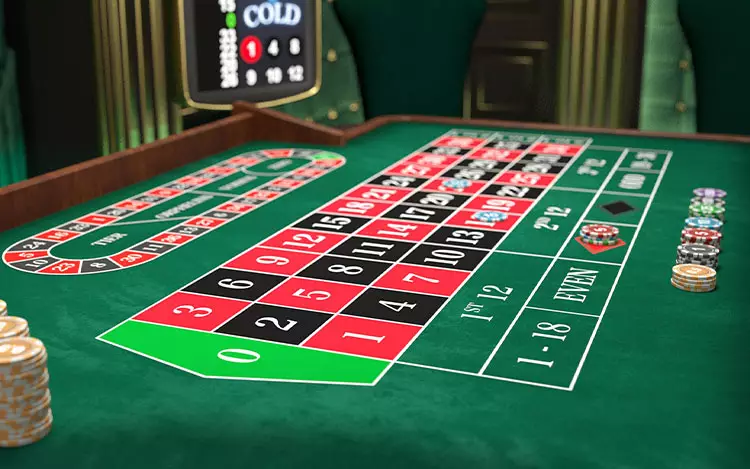
The roulette betting layout is the area where bets are placed. It should not be confused with the numbered wheel itself.
The main grid normally contains numbers 1 to 36, arranged across three columns.
Around that grid are additional spaces for bets covering multiple results.
Inside Areas
Inside bets are placed on the numbered section of the layout or along the lines separating numbered squares.
They include wagers on one, two, three, four or six numbers.
A straight-up bet covers one number, while a corner bet covers four numbers meeting at a common point.
Outside Areas
Outside bets appear around the main number grid.
These include:
- Red or black
- Odd or even
- Low (1–18) or high (19–36)
- First, second or third dozen
- One of three columns
Most outside bets cover either 12 or 18 numbers.
Where Is Zero on the Table?
Zero appears separately from the numbers 1 to 36, usually at the end of the main number grid. An American layout also includes double zero.
Neither zero is automatically included in standard outside bets.
Certain French Roulette rules treat zero differently for qualifying even-money wagers. Those exceptions depend on the specific game.
Roulette Bets Explained
Roulette bets are generally divided into two groups: inside bets and outside bets.
The distinction describes how many numbers a bet covers and where it is placed on the table.
Inside Bets
Inside bets cover individual numbers or small combinations of numbers.
|
Bet |
Numbers covered |
Standard payout |
|
Straight up |
1 |
35:1 |
|
Split |
2 |
17:1 |
|
Street |
3 |
11:1 |
|
Corner |
4 |
8:1 |
|
Six line |
6 |
5:1 |
A straight-up bet covers one specific number. If that number appears, a £1 stake would return £35 in net winnings, plus the original stake.
A split bet covers two adjacent numbers. The chip is placed on the line separating them.
A street bet covers three numbers in a horizontal row on the betting layout, such as 1, 2 and 3.
A corner bet covers four numbers meeting at one corner, such as 1, 2, 4 and 5.
A six-line bet, sometimes called a double street, covers two adjacent rows of three numbers.
These are standard payouts for conventional roulette. Some specialist variants introduce different betting options or payout rules, so the individual game rules remain authoritative.
Outside Bets
Outside bets cover larger groups of numbers.
|
Bet |
Numbers covered |
Standard payout |
|
Red or black |
18 |
1:1 |
|
Odd or even |
18 |
1:1 |
|
Low (1–18) |
18 |
1:1 |
|
High (19–36) |
18 |
1:1 |
|
First dozen (1–12) |
12 |
2:1 |
|
Second dozen (13–24) |
12 |
2:1 |
|
Third dozen (25–36) |
12 |
2:1 |
|
Column |
12 |
2:1 |
An even-money bet pays 1:1. A dozen or column bet pays 2:1.
The payout ratio represents net winnings relative to the stake. For example, if a £2 dozen bet wins, it would produce £4 in net winnings and return the original £2 stake.
A higher payout does not mean that a bet has a better expected result. The number of outcomes covered must also be considered.
Inside vs Outside Roulette Bets
The essential difference between inside and outside bets is how much of the wheel they cover.
An inside bet usually covers fewer numbers and offers a higher payout. An outside bet covers more numbers and offers a lower payout.
Consider a standard European wheel:
- A straight-up bet covers one of 37 pockets.
- A six-line bet covers six of 37 pockets.
- A red bet covers 18 of 37 pockets.
A red result is therefore more likely than one particular number, but the red bet pays substantially less.
For standard European Roulette, these different bet structures generally retain the same underlying house edge.
Mega Casino Tip: A payout and a probability answer different questions. A 35:1 payout describes the net winnings relative to the stake if a straight-up bet wins. On a European wheel, the probability of that result is approximately 2.70%, not 35%.
European vs American vs French Roulette

Roulette variants may appear similar, but differences in wheel configuration and settlement rules affect the mathematics.
|
Variant |
Pockets |
Zero pockets |
Standard house edge |
|
European Roulette |
37 |
0 |
2.70% |
|
American Roulette |
38 |
0 and 00 |
5.26% for standard bets |
|
French Roulette |
37 |
0 |
Usually 2.70%; potentially 1.35% on qualifying even-money bets with La Partage |
European Roulette
European Roulette has one green zero and 36 red and black numbered pockets.
The standard house edge is approximately 2.70%. This applies to conventional bets with the usual payouts.
The mathematics does not change because one number has appeared frequently or because a player changes the size of their stake.
American Roulette
American Roulette adds a double-zero pocket.
That creates 38 possible outcomes instead of 37, while standard payouts remain unchanged.
The resulting house edge is approximately 5.26% for conventional bets. Some special American bets have different mathematics.
French Roulette
French Roulette generally uses the same 37-pocket configuration as European Roulette.
Some tables offer additional rules affecting even-money bets when the ball lands on zero.
La Partage means that, on a qualifying even-money wager, half the stake is returned when zero appears. The other half is lost.
With this rule, the effective house edge on those qualifying bets becomes approximately 1.35%.
En Prison is a different rule under which a qualifying even-money bet may remain in place after zero appears, to be resolved under the table's subsequent-spin rules.
The precise treatment of an imprisoned bet, including repeated zero results, depends on the game rules.
Not every French Roulette game includes these features. The displayed rules should always be checked.
For more detail on why the house edge differs, see Roulette Strategy: An Honest UK Guide.
How to Play Roulette Online

Online roulette follows the familiar roulette betting structure, but the interface replaces physical chips and a conventional betting layout with digital controls.
Two main formats are commonly available: RNG roulette and live dealer roulette.
Digital Roulette Using an RNG
In digital roulette, the game software determines the result through a Random Number Generator.
The screen typically shows a wheel, a betting grid, the chip values and the result of the round.
The displayed wheel animation represents the result produced by the game.
Results are determined by a Random Number Generator (RNG). Outcomes are based on chance only.
This statement applies to RNG-based roulette. In live roulette, a physical wheel and ball determine the result.
Live Dealer Roulette
Live roulette uses a real wheel operated by a croupier and streamed through a video interface.
Players place bets digitally while watching the physical round.
The dealer announces the result, and the software settles wagers based on the winning pocket.
Although the presentation differs from an RNG game, the roulette probabilities still depend on the wheel configuration and the applicable rules.
Understanding the Online Betting Screen
Most online roulette interfaces present several pieces of information:
- Game variant: The type of roulette being played.
- Chip denomination: The value represented by the selected chip.
- Betting grid: The available numbered and outside-bet positions.
- Betting window: The period during which wagers can be placed.
- Table limits: The permitted minimum and maximum wagers.
- Game information: The rules and payout details.
- Result display: The winning number and settled outcome.
Some interfaces include previous-result histories or visual statistics. These can describe earlier rounds but do not establish what will happen next.
Mega Casino's roulette games page provides an overview of the roulette category.
Online Roulette vs Live Roulette
The main differences between digital RNG roulette and live roulette concern presentation, pacing and how results are generated.
|
Feature |
RNG Roulette |
Live Roulette |
|
Result generation |
Random Number Generator |
Physical wheel and ball |
|
Dealer |
No physical dealer required |
Real croupier |
|
Presentation |
Digital graphics |
Live video stream |
|
Betting interface |
Digital |
Digital |
|
Pace |
Software-controlled |
Depends on live table procedures |
|
Probability |
Based on variant and rules |
Based on variant and rules |
A live presentation does not automatically make a game more favourable, nor does a digital presentation inherently produce a higher house edge.
Two games using the same standard European wheel mathematics and identical payouts have the same theoretical house edge, regardless of whether one is live and the other RNG-based.
Differences arise from the actual rules, wheel configuration or special features, not simply the presence of a croupier.
Roulette Odds and House Edge Explained
Roulette odds are determined by the number of possible outcomes and how many of those outcomes a bet covers.
The house edge describes the casino's theoretical advantage, expressed as a percentage of the amount wagered over a large number of rounds.
It is not a prediction of what an individual player will lose in a particular session.
Calculating a Straight-Up Probability
On a European wheel, there are 37 pockets.
A bet on one number covers one pocket.
The probability of that number appearing is:
1 ÷ 37 × 100 = approximately 2.70%
The standard straight-up payout is 35:1.
Calculating a Red or Black Probability
There are 18 red pockets on a European wheel.
The probability of red appearing is:
18 ÷ 37 × 100 = approximately 48.65%
Black has the same probability.
Zero accounts for the remaining approximately 2.70%.
Red and black are therefore not each 50% outcomes on a single-zero wheel.
Understanding the European House Edge
Consider a £1 straight-up bet.
There is one winning outcome that produces £35 in net winnings and 36 losing outcomes that each lose £1.
The expected net result per £1 wagered is:
(1 ÷ 37 × £35) − (36 ÷ 37 × £1) = approximately −£0.027
That represents an expected loss of approximately 2.7 pence for each pound wagered over a sufficiently large number of comparable bets.
Actual short-term results can be substantially different.
The same principle produces a 5.26% standard house edge on a double-zero American wheel.
Every Spin Is Independent
A roulette wheel does not remember earlier results.
If black appears several times consecutively, this does not make red more likely on the next independent spin.
The probability remains determined by the wheel and the bet, not by the previous sequence.
Can Any Roulette System Guarantee a Win?
The House will Always have the Edge. Players should Never try to recover losses by gambling more. The outcome of the games is always entirely based on luck.
There is no strategy that guarantees a win at roulette.
People searching for how to win at roulette may encounter betting systems that claim to improve outcomes by changing stakes after wins or losses.
These systems cannot change the probability of the next independent spin or remove the house edge.
Examples include Martingale, Fibonacci, D'Alembert and Paroli.
They differ in how stake amounts change, but none alters the fundamental mathematics of the wheel.
Setting financial boundaries can help manage spending. It does not create a winning advantage or make gambling a reliable income source.
The House will Always have the Edge. Players should Never try recover losses by gambling more. The outcome of the games is always entirely based on luck.
Common Roulette Myths
Several familiar ideas about roulette arise from misunderstandings of probability.
Red Must Be Due After Several Black Results
False. Previous outcomes do not make a particular colour more likely on an independent spin.
A Betting System Can Beat the Wheel
A change in stake size does not remove the house edge. Some systems can cause stakes to increase rapidly without changing the likelihood of a winning result.
Hot Numbers Are More Likely to Appear Again
A number appearing frequently in earlier rounds does not establish that it will appear more frequently in future independent rounds.
Covering More Numbers Guarantees a Profit
Covering more numbers can increase the chance that at least one wager wins, but it also changes total spending and payout amounts.
A winning individual bet does not necessarily mean that the combined wagers on that spin produce an overall profit.
Understanding these distinctions helps separate game mathematics from assumptions about patterns.
Responsible Gambling and Roulette
Roulette at Mega Casino should be approached as paid entertainment, not as a means of earning money or recovering losses.
Every bet carries financial risk. The house edge means that the mathematical expectation is negative over repeated play, although individual outcomes fluctuate.
Clear boundaries can help people manage their gambling. These may include deciding on an affordable spending limit before playing, using account financial-limit facilities and taking regular breaks.
Increasing stakes to recover earlier losses can increase exposure to further financial harm. No pattern or strategy makes a recovery certain.
UK-regulated operators are required to provide financial-limit facilities. The availability and operation of individual tools should be checked through the relevant account settings.
Anyone concerned about their gambling can access confidential information and support through GamCare.
Gambling should never take priority over essential spending, work, education, family or personal relationships.
18+ | Play Responsibly. Gambling can be addictive. Only gamble what you can afford to lose.
Roulette Terms Beginners Should Know
|
Term |
Meaning |
|
Straight up |
A bet on one number |
|
Split |
A bet on two adjacent numbers |
|
Street |
A bet on three numbers in one row |
|
Corner |
A bet covering four numbers |
|
Six line |
A bet covering six numbers across two adjacent rows |
|
Dozen |
A bet on one of three groups of 12 numbers |
|
Column |
A bet covering one of the three 12-number columns |
|
Even-money bet |
A wager paying 1:1, such as red or black |
|
Inside bet |
A bet on a number or smaller combination of numbers |
|
Outside bet |
A bet on a larger number group |
|
Zero |
The green 0 pocket |
|
Double zero |
The additional green 00 pocket in American Roulette |
|
House edge |
The casino's theoretical mathematical advantage |
|
La Partage |
A rule returning half of a qualifying even-money stake when zero appears |
|
En Prison |
A rule that may hold a qualifying even-money bet for later resolution after zero appears |
|
RNG |
Random Number Generator, used to produce random results in digital games |
|
Croupier |
The person who operates a traditional or live roulette table |
Roulette FAQs
1. How do you play roulette?
A bet is placed on a number, colour or group of numbers before betting closes. The wheel spins, a result is determined, and wagers covering that result receive their applicable payout. All other wagers lose.
2. How many numbers are on a roulette wheel?
European Roulette has 37 numbered pockets, from 0 to 36. American Roulette has 38 pockets because it includes both 0 and 00.
3. What is the easiest roulette bet to understand?
Red or black is a straightforward bet to understand because it covers the 18 pockets of the chosen colour. It pays 1:1, but the presence of zero means neither colour has an exact 50% chance.
4. What is the difference between inside and outside bets?
Inside bets cover smaller combinations, such as individual numbers, splits and corners. Outside bets cover larger groups, such as red or black, dozens and columns. Their payouts reflect the different numbers of outcomes covered.
5. What is the difference between European and American roulette?
European Roulette uses 37 pockets, including one zero. American Roulette uses 38 pockets, including zero and double zero. The extra pocket increases the standard house edge from approximately 2.70% to 5.26%.
6. How does online roulette work?
Online roulette uses a digital betting interface. In an RNG version, software generates the result. In live roulette, a real croupier operates a physical wheel, with bets placed and settled digitally.
7. Is online roulette random?
RNG roulette uses random number generation, while traditional live roulette relies on a physical wheel and ball. UK gambling technical standards require relevant random outcomes to meet fairness and randomness requirements.
8. Can you win consistently at roulette?
Individual winning results and winning sessions are possible, but they cannot be relied upon. The house edge means there is no system that can produce guaranteed consistent winnings from standard roulette.
9. How do you win at roulette?
A roulette bet wins when the result matches the number or group covered by that wager. For example, a bet on red wins if the winning pocket is red. There is no reliable method for predicting the next result on a fair roulette wheel.
10. Does roulette have a strategy that guarantees a win?
No. Betting progressions, changing stake amounts and following previous results cannot guarantee future outcomes or eliminate the house edge. Roulette remains a game of chance.