
 Published: 17 Sept 2026


Before you stake real money, you probably want to know one thing: does a roulette strategy actually work? The honest answer is that no betting system changes the odds of the game. A roulette strategy can organise how you place your bets, but it cannot alter the house edge built into the wheel.
If you have been searching for the best roulette strategy, hoping it will turn roulette into a reliable win, this guide will save you money by explaining why such a strategy does not exist.
What a good roulette strategy can do is help you manage a session, control your stake, and choose the variant with the least bad mathematics. Below we explain the most popular systems, the Martingale, Reverse Martingale, D'Alembert, Fibonacci and James Bond, exactly as they work, with a worked pound-sterling example. Then we cover the only decision that measurably lowers your expected loss: variant selection.
How Roulette Strategy Works
No staking system changes the house edge on any roulette wheel. European Roulette carries a 2.70% edge, American Roulette 5.26%, and French Roulette 1.35% on even-money bets. Whichever system you use, those numbers stay fixed. A strategy only reshapes how your wins and losses are distributed across a session.
The reason is simple. Every spin of a roulette wheel is an independent event. The ball has no memory of previous results, so the probability of any outcome is the same on spin 1 as it is on spin 100. Systems that manage how you bet, such as setting a stake plan or a session limit, are sensible. Systems that claim to beat the wheel are not. The useful part of this guide is variant selection and bankroll discipline, not a winning formula, because a winning formula for roulette does not exist.
The Martingale Strategy Explained
The Martingale is the most searched roulette system. You place an even-money bet, such as red or black, and every time you lose, you double your next stake. The theory is that one win recovers all previous losses plus a profit equal to your original stake. It sounds logical, which is exactly why it catches so many players out.
Here is a worked example starting at £1 on an even-money bet:
- Spin 1: bet £1, lose. Total staked: £1
- Spin 2: bet £2, lose. Total staked: £3
- Spin 3: bet £4, lose. Total staked: £7
- Spin 4: bet £8, lose. Total staked: £15
- Spin 5: bet £16, lose. Total staked: £31
- Spin 6: bet £32, lose. Total staked: £63
- Spin 7: bet £64, lose. Total staked: £127
- Spin 8: bet £128, lose. Total staked: £255
After 8 losses in a row you would need to stake £256 on spin 9, having already risked £255, all to recover a £1 profit. Many UK roulette tables cap even-money bets well below that level, so a losing run of 8 or 9 spins hits the table maximum before you can double again. Once you cannot double, the system collapses and you carry the full loss. The Martingale does not change the house edge; it trades a lot of small, frequent wins for the risk of one large, session-ending loss.
The Reverse Martingale (Paroli) Strategy
The Reverse Martingale, also called the Paroli, flips the logic. Instead of doubling after a loss, you double after a win. The idea is to ride a hot streak while keeping losses small when the run breaks. Players typically set a target, such as three wins in a row, then bank the profit and start again at the base stake.
Like every other system, the Paroli does not change the house edge. Its practical weakness is that streaks end without warning. A single loss returns you to your base stake and erases the gains from the winning run if you have not already taken them off the table. You are still betting into the same fixed 2.70% edge on European Roulette, spin after independent spin.
The D'Alembert Strategy
The D'Alembert is a gentler progression. You increase your stake by one unit after a loss and decrease it by one unit after a win, rather than doubling. If your unit is £1, a loss takes you to £2, another loss to £3, and a win brings you back down to £2. The slower climb means your stakes rise far less aggressively than under the Martingale.
That gentler feel is the appeal, but it is also the trap. The D'Alembert does not change the house edge. It loses money at exactly the same expected rate over time as any other approach, because each spin still faces the same fixed edge. It feels safer, which is not the same as being safer.
The Fibonacci Strategy
The Fibonacci system sizes your stakes using the sequence where each number is the sum of the two before it: 1, 1, 2, 3, 5, 8, 13, 21, and so on. You move one step forward after a loss and, when you win, you move two steps back. It sits between the D'Alembert's slow crawl and the Martingale's steep doubling.
The Fibonacci does not change the house edge. It runs into the same problems as the Martingale, just more slowly. A long losing streak still marches your stakes upward until you hit the table limit or run out of bankroll, at which point the sequence cannot recover the accumulated losses. Reaching the failure point takes longer, but the destination is identical.
The James Bond Strategy
The James Bond strategy is a flat coverage bet rather than a progression. In its common form using a £20 unit, you place £14 on the high numbers 19 to 36, £5 on the six-line covering 13 to 18, and £1 on zero. This covers a large portion of the wheel in a single spin, which is why it feels reassuring.
Covering most of the wheel does not change the house edge. On European Roulette you still lose 2.70% of everything you stake over the long term, because the numbers 1 to 12 lose the whole £20 outright whenever the ball lands there. Wide coverage produces more frequent small wins and rarer larger losses, but the underlying maths is unmoved. It is a bet distribution, not an edge reduction.
Improving Your Roulette Sessions
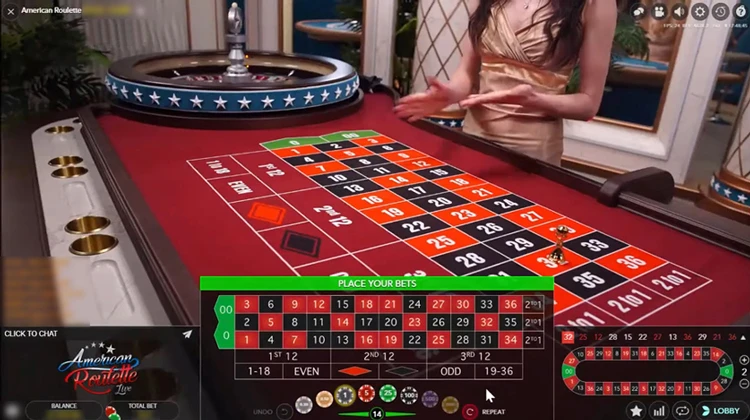
If no system changes the odds, what genuinely helps? Two things: choosing the right variant, and controlling your money.
Variant Selection
The house edge is not the same across roulette games, and this is the one factor entirely within your control before a single spin. On even-money bets, French Roulette carries a house edge of 1.35%, European Roulette 2.70%, and American Roulette 5.26%. American Roulette is worse because of its extra double-zero pocket.
French Roulette's advantage comes from the La Partage rule. When the ball lands on zero, La Partage returns half of any even-money bet to the player instead of losing the whole stake. That single rule halves the effective edge on those bets to 1.35%, the strongest mathematics of any variant. You can see how the different tables behave when you explore French Roulette and the range of live roulette tables available.
Bankroll and Session Discipline
Decide before you start how much you can comfortably afford to lose, treat that figure as the cost of entertainment, and never chase losses by increasing stakes to win money back. Set a session limit too: agree on a time and a loss limit in advance, and stop when you reach either, win or lose. These habits will not make you a long-term winner, because nothing can, but they keep roulette affordable and enjoyable. When you understand the variants, you can try online roulette at Mega Casino knowing exactly what the maths behind each table means.
The Gambler's Fallacy: Why "Red Is Due" Is Wrong
The gambler's fallacy is the belief that past results influence future independent spins. If black has landed 10 times in a row, it feels as though red must be overdue. It is not. On spin 11, red and black remain exactly as likely as they were on spin 1. The wheel has no memory.
This misconception is the engine behind every progression system. The Martingale, Fibonacci, and D'Alembert all quietly assume that a losing run makes a win more probable, so that increasing your stake will eventually pay off. It will not, because each spin is a fresh, independent event against a fixed house edge. A streak of 10 reds tells you nothing about spin 11.
Roulette Strategy: FAQs
What is the best roulette strategy?
There is no staking system that changes the house edge, so no betting progression qualifies as a genuinely winning strategy. The best decision you can actually make is variant selection. French Roulette's even-money bets carry a 1.35% house edge thanks to the La Partage rule, the strongest mathematics of any roulette variant. Combining the lowest-edge game with a set bankroll and session limit is the most sensible approach.
Is the Martingale strategy legal in the UK?
Yes, the Martingale is completely legal to use in the UK, and casinos do not prohibit it. Legality is not the issue. The problem is practical: table limits cap how far you can keep doubling, so a losing run of 8 or 9 spins reaches the maximum bet before the system can recover your losses. Table limits defeat the Martingale regardless of whether you are allowed to use it.
Can you win at roulette long-term with a system?
No. Over the long term you cannot beat roulette with any betting system, because every spin is an independent event decided against a fixed house edge. Systems change the pattern of wins and losses within a session, but they never alter the underlying probability. Given enough spins, the mathematics of the house edge asserts itself no matter how you stake. Roulette should be treated as entertainment, not as a way to make money.
Which roulette game has the best odds?
French Roulette offers the best odds of the three main variants. Its La Partage rule returns half of any even-money bet when the ball lands on zero, which halves the effective house edge on those bets to 1.35%. That compares with 2.70% on European Roulette and 5.26% on American Roulette. If you are playing even-money bets, French Roulette gives you the lowest expected loss.
Responsible Gambling
Roulette is a form of entertainment, not a way to make money, and no strategy on this page will change that. Play only with money you can afford to lose, and stop when you reach the limit you set. Mega Casino provides tools to help you stay in control, including deposit limits, session limits, reality checks, cooling-off periods and self-exclusion, which you can activate at any time from your account.
If gambling stops feeling like entertainment, free and independent support is available from GambleAware, and the national self-exclusion scheme GAMSTOP lets you block yourself from UK-licensed gambling sites.
Mega Casino is licensed and regulated by the UK Gambling Commission under Licence Number 39326. 18+ | Play Responsibly.
See How the Maths Plays Out at the Tables
Now you know why no roulette strategy beats the house edge, take a look at our best live roulette games to try to find a table that suits your budget and pace.