
 Published: 9 Nov 2026



Learning how to play blackjack starts with one simple objective: finish with a hand closer to 21 than the dealer's without going over 21. You play against the dealer rather than the other players at the table, and each decision is made according to the cards in your hand and the rules of that particular game.
The basic sequence is straightforward. You place a wager, receive your opening cards, check their total, choose from the actions available to you, then compare the final result with the dealer's hand. The details matter, however. Card values, dealer rules, splitting, doubling, payouts and even the treatment of a soft 17 can vary between blackjack tables.
This Mega Casino guide explains those details clearly, including the main blackjack rules, common terminology, online and live formats, settlement maths and the role of chance.
How to Play Blackjack in Six Steps
A blackjack round follows a recognisable sequence. Exact table rules can vary, so the game information should always be checked before a wager is placed.
Step 1: Place the wager
A round begins with the player selecting a stake within the limits shown for that table.
The stake applies to the main blackjack hand. Some games may also show optional side bets, but these are separate wagers with their own rules and payouts. They are not required to play the main game.
Step 2: The opening cards are dealt
The player normally receives two cards. The dealer also receives cards, with at least one card visible to the player depending on the format and rules being used.
The visible dealer card is commonly called the dealer upcard.
Step 3: Check the value of your hand
Cards numbered 2 to 10 count at face value. Jacks, queens and kings count as 10. An ace can count as either 1 or 11, depending on which value can be used without taking the hand over 21.
For example:
- 8 + 7 = 15
- King + 6 = 16
- Ace + 7 can total 8 or 18
- Ace + King totals 21 and is a natural blackjack
A total of 21 made with more than two cards is still 21, but it is not normally classed as blackjack. Blackjack refers specifically to the qualifying two-card hand.
Step 4: Choose from the actions available
Depending on the hand and table rules, the player may be able to hit, stand, double down or split. Some blackjack variants may also offer surrender or insurance.
|
Action |
Basic meaning |
|
Hit |
Take another card |
|
Stand |
Keep the current hand and take no more cards |
|
Double down |
Increase the original stake as permitted by the game and receive one further card |
|
Split |
Divide an eligible pair into two separate hands |
|
Insurance |
A separate wager that may be offered when specified conditions are met |
|
Surrender |
Give up the hand under the variant's rules in return for the settlement specified by that game |
Not every action is available in every situation.
Step 5: The dealer completes the hand
Once the player's decisions are complete, the dealer follows fixed rules specified by the table.
Unlike the player, the dealer does not choose freely whether to hit or stand. The rule set determines what happens at each total. A common format requires the dealer to draw on 16 or below and stand on 17 or above, although treatment of certain hands such as soft 17 can differ between games.
This is why the rules panel matters. The behaviour of the dealer should never be assumed from another blackjack table.
Step 6: The hand is settled
The possible main-hand outcomes include:
- the player's hand is closer to 21 than the dealer's without exceeding 21;
- the dealer exceeds 21 while the player's hand remains valid;
- the player exceeds 21 and busts;
- the dealer has the stronger valid hand;
- both finish with the same qualifying total, producing a push under standard rules.
A push normally returns the original main wager rather than producing a win or loss on that wager.
Mega Casino Tip: Treat the rules panel as part of learning the game. Dealer behaviour, blackjack payouts, splitting rules and doubling restrictions can differ between tables, even though the basic objective stays the same.
Blackjack Rules That Shape Every Hand
Understanding a few core rules makes the rest of blackjack much easier to follow.
Blackjack card values
The standard card values are:
|
Card |
Blackjack value |
|
2 to 10 |
Face value |
|
Jack |
10 |
|
Queen |
10 |
|
King |
10 |
|
Ace |
1 or 11 |
The ace is flexible because its value can change according to the hand.
Suppose you hold Ace + 6. The hand can be counted as 17, with the ace valued at 11, or as 7, with the ace valued at 1.
If another 8 is drawn, treating the ace as 11 would produce 25 and bust the hand. Instead, the ace can count as 1, leaving a total of 15.
This ability to change the ace's value is behind the distinction between soft and hard hands.
Blackjack is not simply another name for 21
A blackjack, sometimes called a natural blackjack, is normally an ace plus a card worth 10 received as the initial two-card hand.
Examples include:
- Ace + King
- Ace + Queen
- Ace + Jack
- Ace + 10
A hand such as 7 + 7 + 7 also totals 21, but it is not a natural blackjack because it took three cards to reach the total.
That distinction matters because blackjack can be treated differently from an ordinary total of 21 for settlement purposes.
Mega Casino Tip: Keep “blackjack” and “21” separate in your mind. Every blackjack totals 21, but a hand totalling 21 is not necessarily a blackjack.
Going over 21 means the hand has busted
A player hand above 21 is a bust.
For example:
10 + 8 + 5 = 23.
The hand has exceeded 21 and is settled as a loss under standard blackjack rules. A later dealer bust does not reverse a player bust that has already occurred.
Equal totals can produce a push
If the player and dealer finish with the same qualifying hand total, the result is generally a push.
For example:
Player: 10 + 8 = 18Dealer: Queen + 8 = 18
Neither hand is higher, so the main wager is normally returned.
The table's own rules remain the final reference for settlement.
Dealer rules are fixed by the game
The dealer follows a defined procedure rather than making strategic choices.
The important point for beginners is not to memorise one universal dealer rule, but to recognise that the rule can affect how a particular blackjack table behaves.
One of the most common distinctions involves soft 17. A soft 17 contains an ace that can still count as 11, such as Ace + 6.
One table may require the dealer to stand on that hand. Another rule set may treat it differently. Check the game information rather than carrying assumptions from one version to another.
Blackjack payouts should be checked, not assumed
Payout rules can vary between blackjack games. That includes the payment applied to a natural blackjack.
The arithmetic itself is simple once the paytable is known.
If a £10 winning wager pays at 1:1, the win amount is £10 and the original £10 stake is also returned.
If a game's rules specify a 3:2 payout, the mathematical win on a £10 qualifying wager is:
£10 × 3 ÷ 2 = £15
The original stake is then returned according to the game's settlement rules.
This is an explanation of ratio maths, not a statement that every Mega Casino blackjack table pays 3:2. Always check the specific game's information and paytable.
Blackjack Decisions Explained Clearly
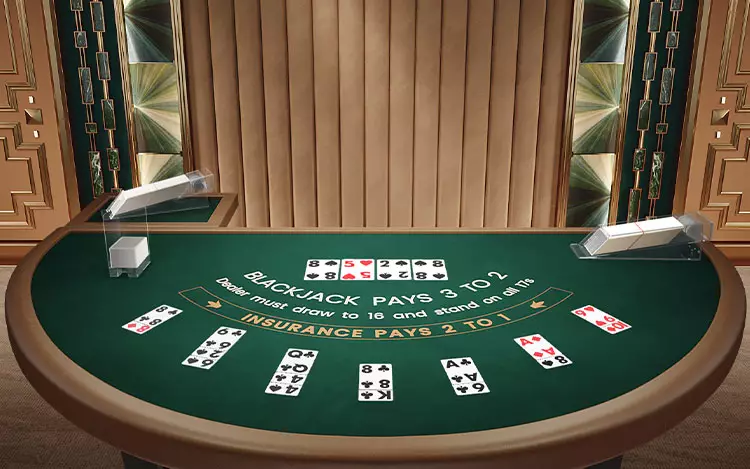
Blackjack differs from games in which the player has no decisions after placing the initial wager. During a hand, several actions may be available.
Understanding what those actions mean is different from being told which one to choose.
Hit
To hit means requesting another card.
A player may sometimes hit more than once, provided the hand remains active and the game's rules allow another card.
Each additional card changes the total and can also change whether an ace counts as 1 or 11.
Stand
To stand means taking no more cards.
The player's current total becomes the final total for that hand, after which the dealer's hand is completed according to the table rules.
Double down
A double down changes both the stake and the way the hand proceeds.
In a common format, the player increases the original wager by an amount permitted by the table and receives one additional card. Rules differ on when doubling is permitted, including whether it is available after splitting.
For that reason, “double down” should be understood as a game action rather than as a universal instruction with identical rules everywhere.
Split
If the opening cards meet the game's requirements for a pair, the player may be offered the option to split them into two hands.
Each new hand then receives additional cards and is played separately.
Rules can vary on:
- which pairs qualify;
- whether equal-value cards rather than identical ranks can be split;
- whether hands can be re-split;
- treatment of split aces;
- whether doubling after a split is permitted.
Insurance
Insurance is a separate wager that may be made available in specific circumstances, commonly when the dealer shows an ace.
It is not part of the main blackjack wager. It has its own settlement conditions and should be treated as a separate bet rather than as guaranteed protection for the original hand.
Surrender
Some blackjack variants offer surrender.
Where available, surrender allows the player to end the hand under terms specified by the game. It is not a universal blackjack feature, and the amount returned depends on the rules of the variant.
If surrender is not shown in the game information, it should not be assumed to be available.
Soft Hands and Hard Hands in Blackjack
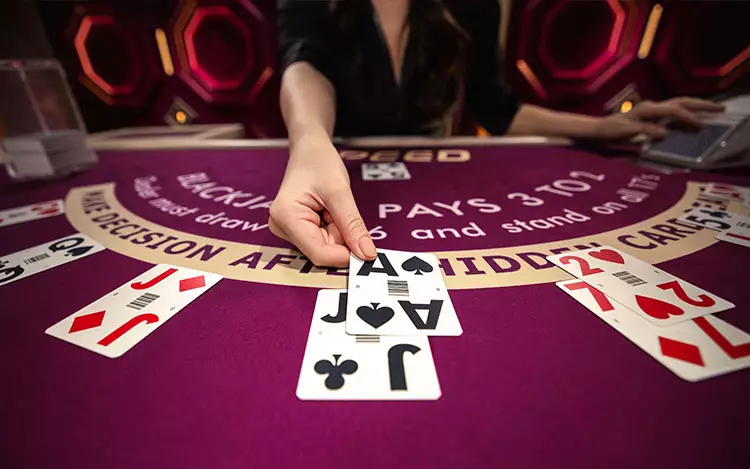
Soft and hard hands are terms used to describe how an ace affects the value of a blackjack hand.
Soft hand
A soft hand contains an ace that can currently count as 11 without the total going above 21.
Example:
Ace + 7 = soft 18.
The ace can count as 11, giving 18, but it could also fall back to 1 if another card makes that necessary.
Hard hand
A hard hand either contains no ace or contains an ace that must currently count as 1 to avoid exceeding 21.
Examples:
10 + 7 = hard 17.
Ace + 6 + 10 = hard 17 because the ace can no longer count as 11.
The terminology does not mean that one type of hand is inherently “good” or “bad”. It describes how the total is constructed.
How to Play Blackjack Online
The basic blackjack online rules follow the same underlying aim: build a valid hand closer to 21 than the dealer's.
The presentation can differ considerably between digital RNG blackjack and live-dealer blackjack.
A typical online process is:
- Select a blackjack game.
- Open the information or rules panel.
- Check the stake range, dealer rules and paytable.
- Place the wager.
- Receive the opening hand.
- Use the on-screen controls for any available action.
- Allow the hand to settle before the next round.
Readers who have finished learning the rules can explore the available blackjack games at Mega Casino, where individual game information should be checked before play.
RNG blackjack
In digital RNG blackjack, the game software generates the result electronically according to its game system.
Results are determined by a Random Number Generator (RNG). Outcomes are based on chance only.
The player's permitted decisions still determine how their own hand proceeds, but those decisions do not remove the role of chance or make a particular result certain.
Live blackjack
Live blackjack presents the game through a live-dealer environment rather than the same RNG card-generation process used in fully digital blackjack.
Players normally use on-screen controls to submit their decisions while the dealer follows the rules of the table.
The basic vocabulary remains familiar, but the exact table rules still need to be checked.
Readers interested in this format can also explore the live casino section for the available live-table selection.
Online Blackjack vs Live Blackjack

Both formats use recognisable blackjack rules, but the way the game is presented is different.
|
Feature |
RNG blackjack |
Live blackjack |
|
Presentation |
Digitally generated game |
Streamed live table environment |
|
Dealer |
No live dealer on screen |
Live dealer |
|
Card/result system |
RNG-based |
Live dealing process |
|
Player controls |
On-screen |
On-screen |
|
Pace |
Determined by the digital game |
Influenced by the live table process |
|
Rules |
Vary by title |
Vary by table |
Neither format changes the central point that blackjack outcomes contain chance and cannot be predicted with certainty.
The choice between digital and live formats is therefore about presentation and game format rather than a more reliable way to achieve a particular outcome.
Blackjack, Chance and the Meaning of “Winning”
People searching for information about winning at blackjack should start with a clear distinction: there is no method that guarantees a winning blackjack hand or profitable session.
Blackjack includes player decisions, but it remains gambling.
Player decisions can affect the hand, not guarantee the outcome
The cards dealt are uncertain. A decision to hit, stand, split or double changes how the player's hand develops, but it cannot reveal or guarantee the next card.
This is also why the result of the previous hand does not determine what must happen on the next one.
A run of dealer wins does not create a debt that the next hand must somehow repay. Equally, a run of player wins does not make another win certain.
Basic strategy is mathematical guidance, not a prediction
The term blackjack strategy often refers to mathematical models that compare the expected results of permitted actions for particular hands and rule sets.
That is not the same as predicting which card will appear next.
A strategy calculation may describe which available choice has the better mathematical expectation under defined assumptions. It cannot guarantee the outcome of an individual hand or remove the casino's mathematical advantage.
This guide therefore explains the concept without presenting gambling recommendations or a decision chart.
House edge describes long-run mathematics
The house edge is a statistical measure associated with the rules of a casino game.
It does not mean the casino must win every hand, nor does it tell a player what will happen in one session.
Blackjack house-edge figures can change with the table's rules and permitted player actions, so a single percentage should not be applied indiscriminately across every blackjack product.
Side bets also use their own rules, paytables and probability structures. Their maths should be considered separately from the main blackjack wager.
Common Blackjack Mistakes for Beginners to Avoid
Many early misunderstandings come from terminology rather than complicated mathematics.
Treating every 21 as blackjack
A three-card 21 is not normally a natural blackjack. The opening two-card combination matters.
Forgetting that an ace can change value
An ace does not permanently become 11 when it is dealt. It may need to count as 1 later in the hand.
Assuming every table uses identical rules
Dealer behaviour, payouts, splitting restrictions and doubling rules can differ.
Misunderstanding a push
A push is not usually a win. It normally returns the main wager because the qualifying totals are equal.
Thinking a split combines into one result
Once a pair is split, the cards form separate hands. Each is completed and settled according to the game's rules.
Treating insurance as guaranteed protection
Insurance is a separate wager with its own conditions. Its name does not mean the original hand is automatically protected from loss.
Believing previous hands dictate the next one
Earlier results do not provide a guarantee about the next hand.
Chasing a previous loss
Increasing involvement because of an earlier loss changes the amount at risk. A previous loss does not make a future win more likely.
Blackjack should be treated as paid entertainment rather than a way to recover money or generate reliable income.
Blackjack Terms Beginners Should Know
|
Term |
Meaning |
|
Blackjack |
A qualifying two-card hand totalling 21, normally an ace and a 10-value card |
|
Hit |
Take another card |
|
Stand |
Take no further cards |
|
Bust |
Exceed a total of 21 |
|
Push |
A tied qualifying result in which the main wager is normally returned |
|
Double down |
Increase the wager as permitted by the rules and receive an additional card under the game's conditions |
|
Split |
Divide an eligible opening pair into separate hands |
|
Dealer upcard |
The dealer card visible to players |
|
Soft hand |
A hand containing an ace that can count as 11 without busting |
|
Hard hand |
A hand with no flexible ace currently counting as 11 |
|
Natural |
Another term commonly used for a two-card blackjack |
|
Insurance |
A separate wager available under specified conditions |
|
Surrender |
An optional rule allowing a hand to be ended under the game's stated settlement terms |
|
Side bet |
A wager separate from the main blackjack hand |
|
House edge |
A mathematical long-run advantage incorporated into a game's rules |
Responsible Blackjack Play
Blackjack involves real financial risk. The purpose of playing should remain entertainment, not income, debt repayment or a way to recover previous losses.
Setting personal limits before gambling can make those boundaries clearer. If the amount of money or time involved stops feeling comfortable, ending the session is a reasonable decision. There is no need to continue because of what happened in an earlier hand.
For anyone concerned about their own gambling or somebody else's, independent support is available through UK safer-gambling services.
18+ | Play Responsibly | GambleAware.org
Blackjack FAQs
What is blackjack?
Blackjack is a casino card game in which the player's aim is to finish with a valid hand closer to 21 than the dealer's hand. A hand above 21 busts. A natural blackjack is normally an ace and a 10-value card dealt as the opening two cards.
How do you play blackjack?
A standard round begins with a wager and an opening two-card hand. After checking the card values, the player chooses from the actions permitted by the table, such as hit or stand. The dealer then completes their hand according to fixed rules, and the two valid hands are compared.
What are the basic blackjack rules?
Number cards count at face value, picture cards count as 10 and aces can count as 1 or 11. Going above 21 busts the hand. The dealer follows fixed drawing rules, while the player's available actions can include hit, stand, double or split. Exact rules vary between blackjack games.
Does blackjack have to equal exactly 21?
No. A player can win with a valid total below 21 if it beats the dealer's valid hand. For example, a player total of 19 can beat a dealer total of 18. The player does not need to reach 21.
Is a three-card 21 blackjack?
Normally, no. Blackjack refers to a qualifying opening two-card hand totalling 21, usually an ace together with a 10, jack, queen or king. A total of 21 made with three or more cards is still 21, but it is not a natural blackjack.
What does the dealer have to do in blackjack?
The dealer follows the rules specified for the table. A common structure requires the dealer to draw on lower totals and stand once the required threshold is reached. Treatment of soft 17 can vary, so the individual game's rules should be checked.
What is a soft 17?
A soft 17 is a total of 17 containing an ace that can still count as 11. Ace + 6 is the simplest example. Because the ace could fall back to a value of 1, the hand is described as soft.
Can you split any two cards in blackjack?
No. Splitting is available only when the opening cards satisfy that game's requirements. Rules can differ on eligible pairs, re-splitting, split aces and whether doubling is available after a split.
How does blackjack online work?
Online blackjack follows the same central objective as table blackjack. Digital versions use on-screen controls and may use an RNG to produce game results. Live blackjack is presented from a live-dealer table. Rules, limits and payouts should be checked for the individual title before play.
Players can view the available Mega Casino blackjack games or browse the live casino at Mega Casino for live-table formats.
Is there a guaranteed way to win at blackjack?
No. Blackjack outcomes involve chance, and there is no strategy that guarantees a winning hand or profitable session. Mathematical blackjack strategy can describe the expected effect of different decisions under specific rules, but it cannot predict the next card or remove financial risk.